Inspiration From Overseas

Welcome to the last blog post of the semester! I cannot believe that first semester is coming close to an end! So far, I have gained a lot of musical insight during this project, and I cannot wait to learn more next semester!

As stated in my previous blog post, I was unable to practice over Thanksgiving Break because I was going on a cruise to the Caribbean. However, I had the opportunity to attend numerous shows while on the ship. The show that stood out the most was called “My Life in Music” because it showcased famous songs from the stage and theater. In fact, I was so intrigued by the play that I decided to find the sheet music for my favorite song from the show: “Time to Say Goodbye” by Andrea Bocelli and Sarah Brightman.

Image by Edward Hoa via Pinterest

“Time to Say Goodbye” is written in the key of G major for most of the song and switches to the key of A major for the last section. The G major key signature contains only 1 sharp (F sharp) while the A major key signature contains 3 sharps (F sharp, C sharp, and G sharp). This key change presents a challenge since there is a significant increase in the number of sharps, but luckily, it only lasts for a couple of measures.

The most challenging component of the piece is the rhythm since most of the notes are either triplets or sixteenth notes. However, these notes in particular are easier to play than traditional triplets and sixteenth notes since many of the notes are played like a scale, meaning that the note that immediate follows is often one finger above or below the previous finger in terms of finger placement. Additionally, the tempo is going to be slower than normal because the song is meant to be sung in operas, making it easier to play the notes.

While playing the piece, I found myself forgetting to play the “coda” when appropriate. This means that the player will play until the measure marked “D. S. To Coda”. Immediately after that measure, the player will play the measure marked with the corresponding Coda sign (looks like a backwards S that is divided diagonally) until the “To Coda” measure pops up. The “To Coda” measure indicates that the player will jump to the measure marked by the other Coda sign (looks like an oval with a cross) and play until the end of the song. Additionally, I often played the triplets like eighth notes rather than in the appropriate rhythm. My most significant strength was having strong intonation during the measures written in the key of G major since there was only 1 sharp to look out for.

Overall, I learned that it is much easier to play opera songs because they are often riddled with scales and are written in a much slower tempo than most songs. Furthermore, I learned that it is extremely challenging to play triplets when it is proceeded by an eighth note since I tend to carry the eighth note rhythm onto the triplets, which is completely inaccurate. For myself, I learned that I pay little attention to the markings when playing, which is especially troubling when there is a coda in the piece since jumping to the wrong measure at the wrong time simply messes up the entire piece. On the other hand, if I were to play a note out of tune, it would not necessarily jeopardize the entire song since I could quickly fix the note, making the mistake less noticeable. For the rest of the semester until my next blog post, I plan on performing more duets in front of my family since the holidays are around the corner. Additionally, I plan on learning more scales and different positions such as third position and second position.

Image by untilnexttime_ via Twitter
Practice, Practice, Practice!

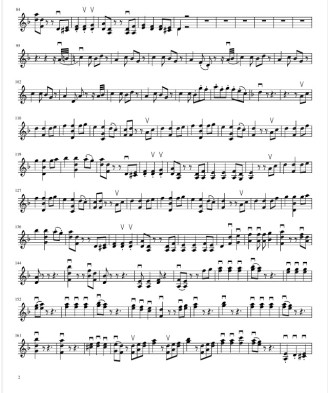
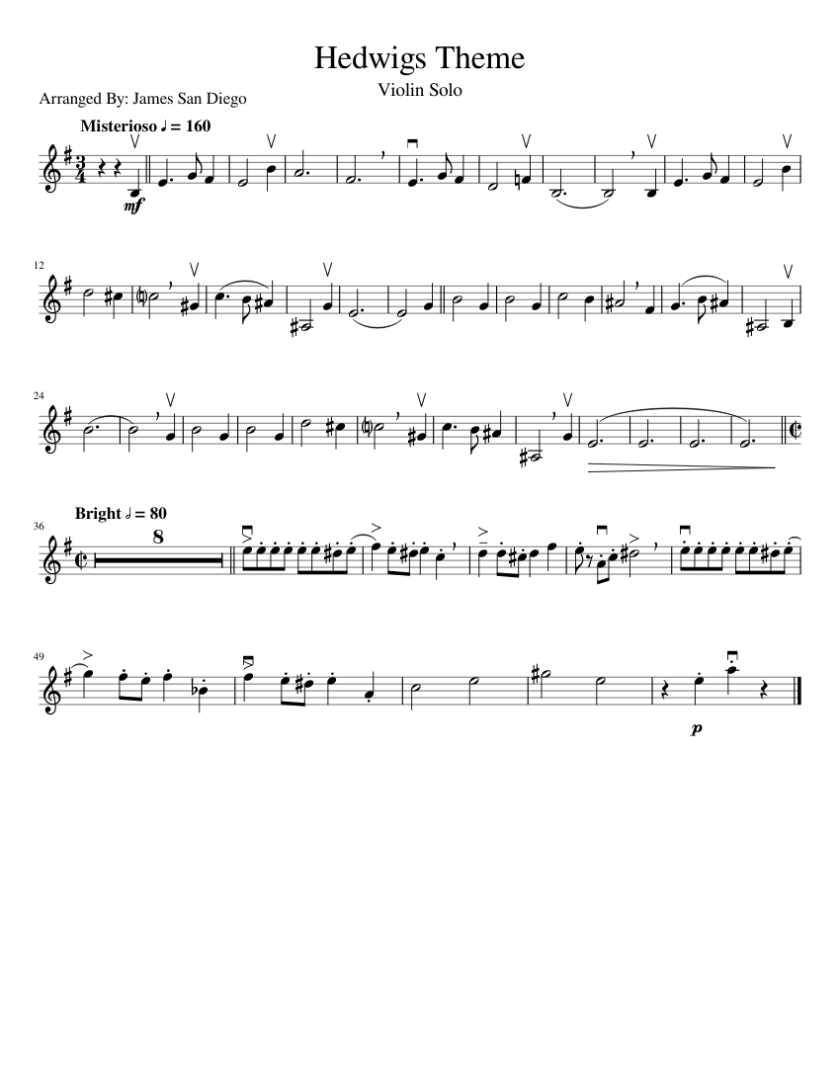
The focus of this week is stated in the title: practice.  If I have to be honest, I was growing a little bored of playing the same songs over and over. As a result, I spent most of this week practicing various short songs for fun. For example, one of the songs I practiced was “Hedwig’s Theme” from Harry Potter.

Image by Ansel101 via musescore

“Hedwig’s Theme” is written in the key of G because there is one sharp: the F sharp. Additionally, the piece features many bow lifts, which indicates that the player must repeat the previous bow direction. For example, if the first note is played using a downwards bow stroke and there is a bow lift after the note, then the second note will also be played using a downwards bow stroke instead of an upwards bow stroke. The tempo is 160 beats per minute, which means that the first half of the song will be played at an extremely quick tempo. The tempo of the second half is 80 beats per minute, which is a little slower than the first half. Additionally, the word “misterioso” that appears next to the tempo of the first half indicates that the first half of the piece should be played in a mysterious fashion. The word “bright” that appears next to the tempo of the second half indicates that the second half of the piece should be played in an uplifting manner.

The most challenging parts of the piece are the key changes. Many of the notes are sometimes played as sharp, which is not part of the original key signature. As a result, I found myself struggling to play those notes in tune. Additionally, I often missed the bow lifts because I was paying more attention to the notes. This week, I learned that it is more difficult to play a piece written with softer dynamics. Most of the dynamics for “Hedwig’s Theme” were mezzo forte, which made it difficult to play because I tend to play with a lot of power. Furthermore, I learned that it is difficult to slur 4 dotted quarter notes together since I often ran out of bow whenever I attempted to do so. For myself, I learned that I tend to play in the wrong part of the bow, which made my bow lifts weaker. For instance, I would end up in the upper part of the bow before having to repeat a downwards bow stroke, which made the second downwards bow stroke weaker than the first because I had to quickly move to the bottom of the bow, making the note also sound rushed and scratchy. During Thanksgiving Break, I will not be able to work on this project because I am going out of the country. As a result, I cannot take my instrument with me because of the extra baggage fees and I cannot find new music because there will be no internet. However, when I return, I plan on working on “Hedwig’s Theme,” specifically the key changes and bow lifts, because I really like the song.

Christmas is Coming to Town

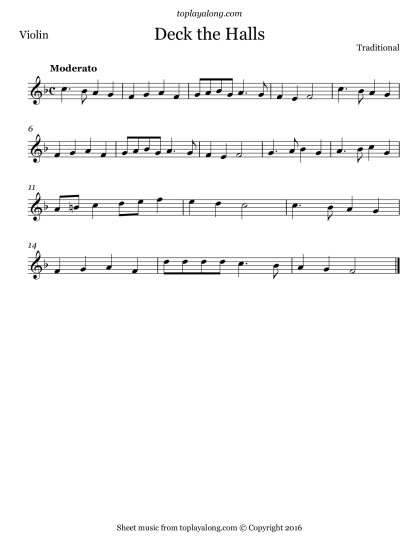
Since I traditionally do not play songs meant for Thanksgiving, I spent this week looking for Christmas songs to play. It was a difficult decision to make because there are so many songs to choose from. I finally settled on “Deck the Halls” and “Joy to the World.”

Image via toplayalong

Image via violinonline

Both songs are easy to play, which allows me to focus on developing tone and mood. During my first run through, I was able to play both pieces with minimal mistakes. Since both pieces do not contain any crescendos, I decided to add some on my own to make the pieces sound more exciting. For example, in the beginning of “Joy to the World,” I wanted to play the first few measures as forte and the next few measures as piano. When it was time to transition to the melody, I would implement a crescendo from piano to forte to highlight the transition and to emphasize the melody. However, my crescendos were often sloppy because I would start them too late in the measure and they would sound rushed. Additionally, I wanted to implement the same crescendo technique to “Deck the Halls,” but I ran into the same problem as I did with “Joy to the World”. Luckily, I have a couple of weeks before Christmas, so I have plenty of time to practice the crescendos.

This week, I learned that although they seem unimportant, dynamics truly shape music since they highlight important transitions and carry the mood throughout the piece. For instance, if a song was only played in one dynamic, the song would seem boring and lifeless. Additionally,  I learned that it is not that difficult to jazz up a music piece when appropriate. For example, I was able to add power to two classic Christmas songs simply by adding 3 – 4 crescendos. For myself, I learned that I tend to focus too much on the notes and forget to stick to the tempo and dynamics. As a result, I had some trouble playing the crescendos because I was too immersed in the melody. Next week, I want to strengthen the crescendos in the two pieces and possibly find more ways to make them sound more interesting. Additionally, I plan on finding more Christmas songs to play since the ones that I picked are pretty short.

The Performance of My Life

Although learning how to play a musical instrument is difficult, the real challenge is presenting your acquired skills in front of an audience. The fact that a single mistake in my performance could undermine my true playing ability almost made me reconsider playing in front of my family. Furthermore, I suffer from performance anxiety and I have the tendency to dig my nails into my skin until I bleed to calm down my nerves. However, I powered through my fear and carried out the performance.

My cousin played alongside me in a duet as we primarily focused on harmonization to mask minuscule mistakes. To avoid further mishaps, we decided to play the same piece we worked on last week, Pachelbel’s “Canon in D.”

image via 123rf

Our audience constituted of my grandparents, her parents, my parents, and my brother. It was quite a full house. When we were finished, every single person gave us a standing ovation, which was nice after such a stressful week. Despite having difficulty in the past, we managed to carry the correct tempo and rhythm throughout the piece. However, we still need to work on our transition from quarter notes to the sixteenth notes in measure 21. I also realized that the faster I play the notes, the less distinct they sound since I tend to play the notes too quickly, producing a scratchy tone. My intonation improved, but my E string notes were still not high enough. Overall, I need to work on bow technique to produce a fuller, richer tone, and intonation to prevent others from cringing when listening to my higher notes.

During the performance, I learned that it is good to only focus on one aspect of the piece to divert attention away from the mistakes. For example, although my intonation was not perfect at some parts (i.e. measure #18), I was able to hide the mistake by making our harmonization stand out. Additionally, I learned that it is more important to improve intonation before perfecting rhythm because a piece that is in tune at a slower pace sounds better than a piece that is out of tune at optimal speed.

For myself, I learned that I do not fare well under the spotlight, even if the audience consists of people who know me best. I knew that I had performance anxiety, but I did not realize the severity of it until I finished playing. For instance, I was shaking during the entire piece, which worsened my tone. Next week, I will try to perform in front of other audiences to see if I can improve my performance anxiety through repeated practice. Additionally, since Christmas is rolling around, I will be on the lookout for Christmas duets to learn with my cousin so we can perform in front of our family once again.

The First Duet

As I previously mentioned in my last blog posts, I am a former member of the Roswell High School Orchestra. That being said, I have had experience in the “duet” area. For example, for final exams, I was required to perform a chosen piece with my assigned group in front of the class. However, there is a major difference between my previous duet experience and my current situation. I only have experience with performing a piece with other individuals while playing the viola. This will be the first time I play the violin in a duet.

Since most of my orchestra friends are busy, I decided to call my cousin to ask her if she was interested in playing a duet with me. Luckily, she was free during the weekend and had sheet music that she wanted to try out. My cousin also plays the violin, so we decided that I would play the second violin part and that she would play the first violin part because she had more experience and could handle the more challenging first violin part. The piece she wanted to play was Johann Pachelbel’s “Canon in D”.

Image by arissira04 via musescore

“Canon in D” is played in the key of D major, which means that it contains 2 sharps: F sharp and C sharp. It was much easier for me to play the notes in tune because the D major scale is the most basic scale for beginner orchestra students. The biggest challenge was being able to harmonize with my cousin because I would speed up at times or she would play slower. We could definitely play the piece by ourselves, but when together, it was difficult to tell when we were playing at different tempos because we were so focused on ourselves and paid little attention to each other.

While working on the duet, I learned that it was extremely difficult to harmonize when the notes were slurred because one person would play the slur too quickly and get slightly ahead. Additionally, the rhythm differed for the parts throughout the piece, making it tough to catch up to the beat. For myself, I learned that I tend to tune out the other instruments when playing in a group, which is detrimental to my playing because I tend to play over the tempo without realizing it. Additionally, it was difficult for me to pay attention to my cousin’s part because I was too busy focusing on playing the rhythm correctly.

Although my cousin and I spent a significant amount of time working on the piece, we were unable to do a complete run through of the piece. As a result, we will continue to work on the piece during this upcoming weekend. I plan on marking each of my entrances with a slightly dramatic bow lift to inform my cousin of where I am in the piece to make sure that we are playing at the exact tempo. Hopefully, we will be ready to play in front of our family during the week after next week.

A Pleasant Reaction

Last weekend, I decided to play “Phantom of the Opera” for my friend. She told me that I had great intonation, but I was playing below the suggested tempo. Additionally, she said that the notes sounded plain and they lacked emotion and feeling. I took her advice to heart and went home to practice. I used a tuner to improve my intonation and a metronome to increase my playing speed. After I pleased with the results, I played the song for her again. She said that the piece was much better than last time and that I had significantly improved my tempo. I was ecstatic. Her words gave me confidence to play a more difficult piece. I decided to tackle one of the most iconic musical pieces from the movie industry: “He’s A Pirate” from Pirates of the Caribbean. 

Image by riky.the1 via musescore

“He’s A Pirate” is played in the key of F major because it only contains 1 flat, the B flat. The song is played at a suggested tempo of 140 beats per minute, which is extremely fast. Although the tempo is much more difficult than the tempo of “Phantom of the Opera,” the notes are much easier to play. As a result, I was able to play most of the notes at a tempo of 100 beats per minute.

This week, I learned that a song played at a high tempo is not necessarily difficult to learn if the notes are played in a easier scale. This allows me to focus more on the rhythm because I do not have to worry too much about the intonation because the notes will not be particularly difficult to play. Additionally, I learned that I progressed more after playing in front of my friend versus repeatedly listening to my recordings by myself. When I listen to my recordings, I tend to ignore the tiniest flaws, but when I play in front of my friend, she is able to point out the little mistakes. It is also extremely important to rely on a tuner and a metronome to help improve your playing. Next week, I plan on diving deep into “He’s A Pirate” and possibly performing a duet with the piece. I also plan on getting feedback from a friend who plays violin for a professional orchestra.

A Slow and Steady Progress

Over the five-day break, I was finally able to play Carlos Gardel’s “Por Una Cabeza.” Although I played slightly under the suggested tempo, I could play the slurs with ease. Hopefully one day, I will reach the recommended tempo, but for now, I am happy that I can play the song from start to finish without any major mishaps. I will continue to work on perfecting the piece and plan on preparing a performance in front of my family for feedback. I have decided to split the song into sections and repeatedly play each section until I reach the tempo since I find that the method works when I am practicing a new song on the piano.

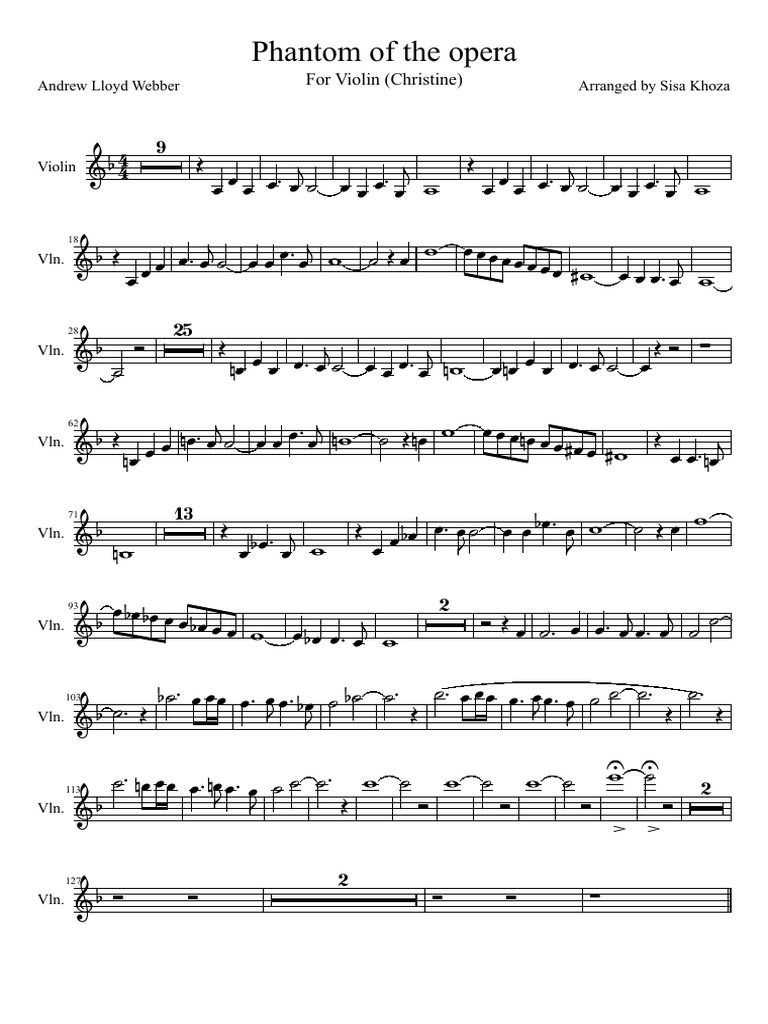
Image by Scribd via Pinterest

Additionally, I have always been intrigued by the theme song from the Phantom of the Opera because of the powerful emotion displayed in the chords. I also decided to practice the song over the break to get a feel of the emotion. The song is riddled with chromatic scales in the beginning and transitions to a more intense, higher-pitched melody. My intonation on the chromatic scale is a little off because it is hard to shift to the right note at such a fast tempo. Furthermore, I am finding it difficult to carry out the vibrato in the later half of the song. I plan on playing each note in the chromatic scale as a quarter note and slowly putting the notes together as I fully grasp the tempo.

I have learned that it is easier to start slow on sections of a piece and gradually increase the tempo rather than playing the entire song at a slower pace and increasing the tempo. Additionally, I have learned that although the chromatic scale is easy to play on its own, when putting it into context, it is difficult to play each note in tune. For myself, I noticed that I tend to be overconfident when approaching a song, which explains the lazy attitude I have towards each of the songs. I also noticed that it is hard for me to vibrato because I have been maintaining the same incorrect posture for 7 years. I plan on implementing some posture exercises throughout the following week to break the habit.

Next week, I am going to work on improving the current songs because I have a lot of assignments coming up, making it very difficult to start practicing new songs. I plan on sending recordings to some of my orchestra friends for feedback and possibly picking out a simple song for a duet.

A Step in the Wrong Direction

As I stated in last week’s blog post, my goal was to be able to play Carlos Gardel’s “Por Una Cabeza” by the end of this week. If I have to be honest, I was not able to complete this task because I overestimated the amount of time I could dedicate to this goal. Due to the amount of assignments I had this week, I could only work on this goal during the weekend, which gave me barely enough time to practice. I also made the mistake of creating the goal before looking at the sheet music.

(image via toplayalong.com)

“Por Una Cabeza” is most known for being featured in an iconic tango scene in the movie Scent of a Woman (1992). There is a drastic shift in tempo and tone in the middle of the song. The song begins with a pleasant, fast melody and later shifts to a more intense, slower beat. To put this into context, the beginning of the song sounds like a song that would be played in a field of flowers where birds are chirping and the sky is clear and sunny. The second half of the song sounds like a song that would be played during the middle of a fight scene.

Although the notes are not particularly hard to play, the rhythm throws me off. It is important to correctly play the rhythm because it establishes the mood of the piece and creates a beautiful story. The song is riddled with eighth-notes and sixteenth-notes, which means that the song is played at a faster tempo. The faster tempo combined with the slurs makes it hard to play the notes in tune. Additionally, the song contains more high-pitched notes, which are easier to detect when they are out of tune.

During my practice time, I was able to play most of the notes as quarter notes at a slower pace. I was unable to incorporate the slurs because it is harder to slur multiple notes rather than the usual two-note slur. I also did not realize that the song contains triplets, which are series of 3 notes that are played in a quick succession. I also discovered that there is a major change in key, as the beginning of the song is played in the key of G while the later half is played in the key of B flat. As a result, I must be cautious when the shift takes place since both keys feature different notes.

I learned that it is important to create a detailed plan before committing yourself to a goal, as seen in this week’s blog post. I decided to blindly follow this goal without looking over the sheet music and setting time aside to practice. I also learned that it is extremely helpful to listen to the song multiple times before playing to establish the tone of the piece. For example, “Por Una Cabeza” is known for its bold and intense shift from a light melody to a more articulated beat. If the player did not know this beforehand, the song would lose the ability to express emotion to the audience, which is the key goal of the piece.

For myself, I have learned that I tend to play better when I play the song side-by-side with an audio clip of the piece. For example, when I practiced “Por Una Cabeza,” I would play a section of the song, play the clip and compare, and replay the section to make adjustments. I find that this method works best for me because I am an auditory learner. I also learned that I need to work on my time management since it is important to put in a lot of practice time before performing a piece.

After failing to reach my goal for this week, I plan on working on the same goal throughout next week. I will play sections of “Por Una Cabeza” rather than attempting to play the entire song over and over and focus on interpreting the rhythm to correctly express the emotions of the song. Additionally, I plan on working on much simpler, well-known songs such as “We Wish You A Merry Christmas” and “Ode to Joy” to practice rhythm and intonation.

A Shocking Turn of Events

As I mentioned in the previous blog post, I have been playing the viola for 7 years. So when my mother told me that my violin skills outshone my viola skills, I was completely shocked. How could I possibly be better at an instrument that I had just picked up? I decided to investigate the situation.

Throughout this week, I kept playing the same songs on both instruments to confirm my mother’s claims. I played Pachelbel’s “Canon in D”, Yiruma’s “Kiss the Rain” , and “He’s A Pirate” from Pirates of the Caribbean. After listening to the recordings of each song, I realized that my mother was right. I am a better violinist.

How is this possible? I use the same technique to play both instruments. Virtually everything was the same except for the sheet music and strings. I spent the rest of the week playing my recordings to different people and asked them the same question: Am I a better violinist or violist?

To my surprise, they all agreed with my mother. The reasoning behind their opinion attributed to the structure of the two instruments.

They found that the higher-pitched E string was more appealing to the ear than the lower-pitched, more mellow C string. I was confused. I thought that higher-pitched sounds were more annoying because people tend to squirm when higher-pitched notes are played. I decided to take a closer look behind this phenomenon.

It turns out that the structure of the violin makes it sound better. The width of its strings makes it easier to improve intonation. The violin’s E string is much thinner than the viola’s C string, which explains why I can never get my lower notes in tune, hence why I sound better on the violin than the viola. Additionally, my vibrato sounds better on the violin because I find it easier to vibrato on thinner strings.

Throughout this week, I have noticed a great improvement in my intonation. I also figured out my scheduling issue and decided that I would practice in the orchestra room every 2 weeks to give me more time to work on my blog posts. In terms of supplies, I will keep my violin at home and possibly borrow a friend’s at school to avoid carrying the instrument around. I am still struggling on my vibrato because I have developed a habit of stopping my vibrato halfway through the note, which ruins the effect of the vibrato. My discovery about my violin skills in comparison to my viola skills has definitely shocked me and makes me question if I picked the right instrument 7 years ago.

I have learned that spending more time on developing a skill does not guarantee success, as shown through my investigation. Sometimes, it is not the individual but the conventions/methods used to develop the skill. I have relied on self-teaching for many of my skills, and this discovery makes me question the effectiveness of self-teaching versus traditional learning with a mentor.

After the events of this week, I plan on focusing more on the violin and making more recordings to show to my family and friends. My goal next week is to play Carlos Gardel’s “Por Una Cabeza” and to start spending more time getting advice from my orchestra teacher to improve my intonation and vibrato.


And The Challenge Begins…

Before I start this blog post, I have something to confess. Since I have been playing the viola for 7 years, I believe I have an advantage over those who have never played an instrument similar to the violin.

https://www.google.com/url?sa=i&rct=j&q=&esrc=s&source=images&cd=&cad=rja&uact=8&ved=2ahUKEwiq0dmZ07rdAhUjUt8KHf7vDbAQjRx6BAgBEAU&url=http%3A%2F%2Fwww.yookamusic.net%2Fhow-to-tell-the-difference-between-viola-and-violin%2F&psig=AOvVaw0uIM74K4nqQS7TyA5rBRmR&ust=1537019824894080

That being said, the viola and the violin are alike in many ways. However, they are not the same instrument. Although both instruments are played in the same manner, the viola has the C, G, D, and A, strings while the violin has the G, D, A, and E strings, making the two instruments different in terms of the notes resonating from each instrument. Additionally, the viola is played in the alto clef, while the violin is played in the treble clef, which indicates that violin music is completely different from viola music. Therefore, I may be familiar with the bowing technique, intonation, and hand placement on the violin, but violin music is an entirely different language.

I have to admit, given my music background, I began this project thinking that it was going to be a piece of cake. However, I soon discovered that this task was not as easy as I hoped it would be. In fact, obtaining a violin was hard enough by itself. Luckily, a close friend of mine had to switch instruments and lent me his violin. The next obstacle was figuring out the logistics behind my project, mainly practice time at school. I needed to plan when to bring the violin to school and when to keep it at home while making sure that I always had my material with me. Since I tend to carry numerous things with me to school, carrying an instrument around only makes it harder to navigate through school without getting angry looks in the hallway. I am still trying to figure out when to schedule practice time at school without accidentally bringing the violin to school for no reason, but hopefully, I can figure this all out when I start my trial practice session on Friday.

I have also began to practice at home to make sure that I am keeping track of my deadlines. While playing, I noticed that the violin produces a louder and richer sound than the viola does, which is surprising since I have always been told that the viola is “the heart of the orchestra”. Additionally, I tend to play the E string notes out of tune, which makes sense since the viola does not have an E string, so I am not familiar with it, but the E string on the violin and the A string on the viola are located in the same spot and my intonation on the A string on the viola is decent, so maybe I need to place my hand a little higher than I normally would due to the high pitch of the E string. I have also discovered that if I play the same song on both the violin and the viola, the one played on the violin sounds better, which is strange since I have been playing the viola longer. I also learned how to play the two-octave G scale on the violin in first position and my goal for next week is to learn how to play the same scale but in third position to improve my shifting in preparation for more challenging music compositions.

As I reflect on this experience, I have realized that having a music background does not necessarily mean that it is easy to play any instrument because each instrument is unique in terms of technique and clef. That being said, I need to treat the violin as its own instrument, not as an instrument that closely resembles the viola to improve my intonation. I also discovered that my fourth finger notes tend to be out of tune, so I need to practice playing those notes with a tuner. Most importantly, I have learned that since the notes on the violin have a higher pitch than the notes on the viola, it is important to have precise intonation because it is more obvious when a note with a higher pitch is out of tune versus a note with a lower pitch.

Thank you for joining me on my journey and stay tuned for next week’s blog post!